
The Defensive Reasoning Advantage: GPT-5.5-Cyber and Trusted Access
On May 7, 2026, the cybersecurity industry crossed another major threshold in the evolution of AI-driven defense.
OpenAI officially introduced GPT-5.5-Cyber, a specialized security-focused frontier model engineered specifically for cyber defense, vulnerability analysis, forensic investigation, and security operations.
While previous generations of AI assistants helped automate repetitive security tasks, GPT-5.5-Cyber represents something fundamentally different:
A reasoning-centric defensive system capable of understanding attacks at the logic level
This matters because modern cyber threats have changed dramatically.
Attackers are increasingly using:
- Autonomous AI agents
- AI-generated exploit chains
- Adaptive malware
- Automated reconnaissance
- AI-assisted phishing infrastructure
The result is what many researchers now call:
The Automated Exploitation Gap
This is the dangerous time window between:
- A vulnerability becoming discoverable
- Attackers weaponizing it with AI
- Human defenders recognizing and responding
In 2026, that gap has shrunk from weeks to hours—and in some cases, minutes.
At 77 Security, we believe GPT-5.5-Cyber marks the beginning of a new security era:
Machine-speed defensive reasoning
Why Traditional Security AI Is No Longer Enough
Section titled “Why Traditional Security AI Is No Longer Enough”For years, security AI primarily focused on:
- Classification
- Pattern matching
- Alert scoring
- Statistical anomaly detection
Traditional AI security systems could answer questions like:
- “Does this file resemble known malware?”
- “Does this traffic pattern look suspicious?”
- “Does this login deviate from baseline behavior?”
These systems were useful, but fundamentally reactive.
Modern attacks increasingly bypass static indicators entirely.
AI-generated attacks can now:
- Rewrite themselves dynamically
- Mimic legitimate workflows
- Abuse business logic
- Exploit contextual trust relationships
- Evade signature-based detection
This creates a major limitation for traditional security tooling:
It can detect known patterns, but struggles to reason about novel attacker behavior
GPT-5.5-Cyber was designed specifically to solve this problem.
The Core Innovation: Defensive Reasoning Architecture
Section titled “The Core Innovation: Defensive Reasoning Architecture”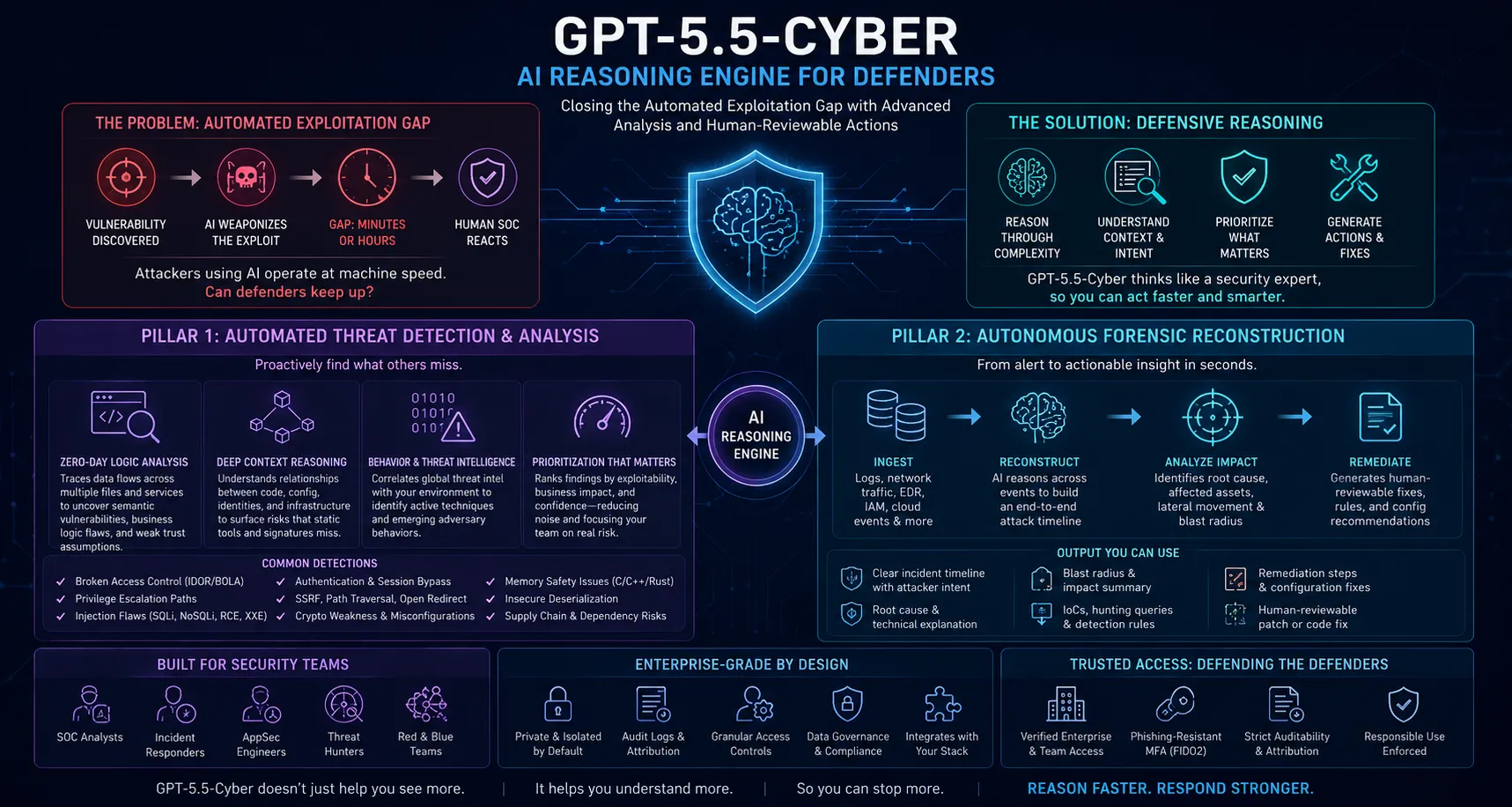
The defining advantage of GPT-5.5-Cyber is not simply scale or speed.
Its real advantage is:
Multi-step defensive reasoning
Instead of merely classifying indicators, the model attempts to understand:
- Attacker intent
- Data flow relationships
- Trust boundaries
- Exploit conditions
- Operational context
This enables the model to function more like:
- A senior security researcher
- A malware analyst
- A forensic investigator
- A red team engineer
rather than a traditional automated scanner.
1. Zero-Day Logic Analysis
Section titled “1. Zero-Day Logic Analysis”One of the most important capabilities introduced in GPT-5.5-Cyber is advanced semantic vulnerability analysis.
Beyond Traditional SAST
Section titled “Beyond Traditional SAST”Traditional Static Application Security Testing (SAST) tools rely heavily on:
- Signatures
- Regex matching
- Rule-based heuristics
These approaches work reasonably well for:
- Hardcoded secrets
- Known insecure functions
- Simple injection patterns
But they consistently struggle with:
- Business logic flaws
- Authorization bypasses
- Complex trust relationships
- Multi-stage exploit chains
GPT-5.5-Cyber approaches code differently.
Instead of searching for patterns alone, it reasons about:
- How systems interact
- How data moves
- Whether security assumptions actually hold
Data Flow and Trust Boundary Analysis
Section titled “Data Flow and Trust Boundary Analysis”The model can trace:
- User-controlled input
- API interactions
- Authentication states
- Backend workflows
- Cross-service dependencies
This allows it to identify:
- IDOR / BOLA vulnerabilities
- Privilege escalation paths
- Broken access control
- Unsafe workflow assumptions
- Hidden authorization bypasses
Importantly, these vulnerabilities often appear:
Perfectly valid from a syntax perspective
This is why many legacy scanners miss them entirely.
Industrial and Critical Infrastructure Impact
Section titled “Industrial and Critical Infrastructure Impact”One of the most significant findings from early GPT-5.5-Cyber evaluations involved:
- Industrial control software
- Operational technology (OT)
- SCADA-related workflows
Researchers observed the model discovering:
- Unsafe command paths
- Weak operator validation logic
- Dangerous fail-open conditions
In several benchmark scenarios, GPT-5.5-Cyber reportedly identified logic-level weaknesses comparable to those discovered by offensive frontier models such as the Anthropic Mythos research platform.
This signals a major shift:
Defensive AI is beginning to rival offensive AI in vulnerability discovery.
2. Autonomous Forensic Reconstruction
Section titled “2. Autonomous Forensic Reconstruction”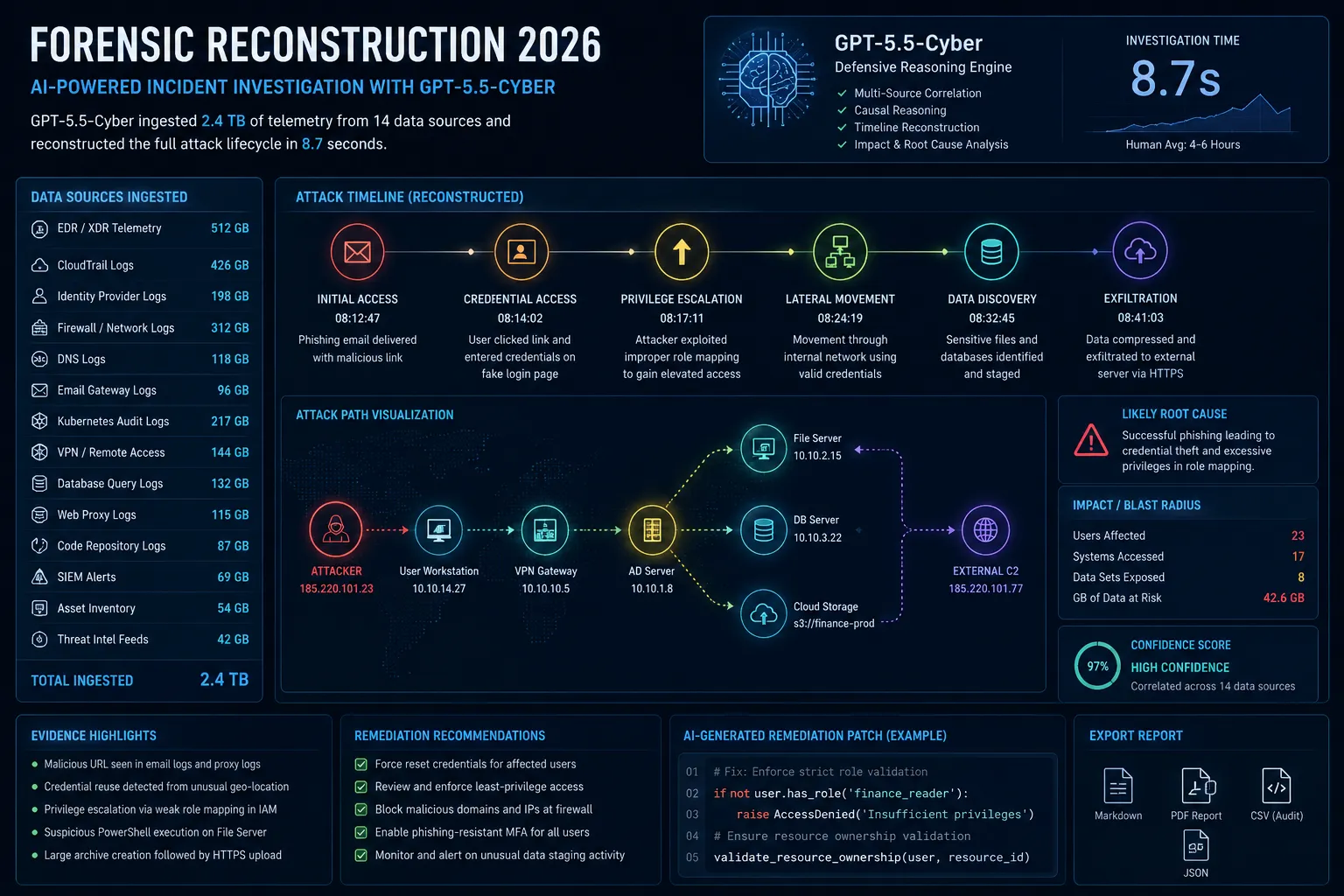
Modern incident response suffers from one major bottleneck:
- Human investigation speed
Large incidents generate:
- Millions of logs
- Thousands of alerts
- Complex event chains
- Multi-cloud telemetry
Human analysts often spend hours simply reconstructing timelines.
GPT-5.5-Cyber significantly changes this workflow.
End-to-End Timeline Construction
Section titled “End-to-End Timeline Construction”The model can ingest:
- EDR telemetry
- CloudTrail logs
- Identity provider events
- DNS traffic
- Firewall logs
- API traces
- Kubernetes audit streams
Using forensic reasoning, it reconstructs:
- Initial access vectors
- Lateral movement paths
- Persistence mechanisms
- Privilege escalation
- Data exfiltration attempts
The result is a readable narrative timeline rather than fragmented alerts.
Blast Radius Analysis
Section titled “Blast Radius Analysis”One of the hardest problems during incident response is determining:
“What exactly was affected?”
GPT-5.5-Cyber can analyze:
- Which identities were compromised
- Which systems were accessed
- Which datasets were touched
- Which credentials may have leaked
This dramatically reduces:
- Investigation time
- Containment uncertainty
- Recovery delays
Human-Reviewable Remediation
Section titled “Human-Reviewable Remediation”The model also generates:
- Suggested containment actions
- Security hardening recommendations
- Patch guidance
- Detection rules
- SOAR workflow logic
Crucially, OpenAI positions these outputs as:
Human-reviewable recommendations—not autonomous production actions
This distinction is important.
The Trusted Access Model
Section titled “The Trusted Access Model”One of the most controversial aspects of GPT-5.5-Cyber is its restricted availability.
Unlike consumer AI systems, access to GPT-5.5-Cyber is gated behind OpenAI’s:
Trusted Access framework
The reasoning is straightforward:
- A model capable of finding advanced vulnerabilities could also be abused offensively.
Why Restrict Access?
Section titled “Why Restrict Access?”Modern frontier cyber models can potentially:
- Accelerate exploit discovery
- Analyze attack surfaces
- Optimize phishing campaigns
- Identify weak security controls
Without safeguards, such systems could dramatically lower the barrier for offensive cyber operations.
Trusted Access is OpenAI’s attempt to balance:
- Defensive utility
- Misuse prevention
Components of Trusted Access
Section titled “Components of Trusted Access”1. Verified Identity
Section titled “1. Verified Identity”Access requires:
- Enterprise or approved Team accounts
- Organizational verification
- Employment validation for cybersecurity roles
Eligible users may include:
- Security engineers
- SOC analysts
- Incident responders
- Threat researchers
- CISOs
This creates accountability and traceability.
2. Phishing-Resistant Authentication
Section titled “2. Phishing-Resistant Authentication”Standard MFA is no longer considered sufficient for high-risk AI systems.
GPT-5.5-Cyber requires:
- Hardware security keys
- Passkey authentication
- Phishing-resistant login methods
This reflects a broader industry realization:
AI systems themselves are becoming critical infrastructure.
3. Auditability and Attribution
Section titled “3. Auditability and Attribution”All interactions with GPT-5.5-Cyber are heavily logged.
This includes:
- Queries
- Generated outputs
- Uploaded artifacts
- Security analysis requests
The goal is deterrence through attribution.
If the platform is abused to:
- Generate malicious tooling
- Analyze unauthorized targets
- Assist offensive operations
activity can theoretically be traced back to verified users.
The Dual-Use Dilemma
Section titled “The Dual-Use Dilemma”GPT-5.5-Cyber highlights one of the defining security debates of the AI era:
How do we deploy powerful cyber AI defensively without enabling offensive misuse?
This is known as the:
- Dual-use problem
The same reasoning capabilities that help defenders:
- Find vulnerabilities
- Analyze malware
- Investigate attacks
could also help attackers:
- Discover zero-days
- Improve evasion
- Automate exploitation
Trusted Access represents one of the first large-scale attempts to operationalize:
Responsible frontier cyber AI governance.
The “Overtuning” Risk
Section titled “The “Overtuning” Risk”Despite its capabilities, GPT-5.5-Cyber is not infallible.
A May 2026 study from Oxford University highlighted concerns around:
- “Overtuned” models
These are models excessively optimized for:
- Helpfulness
- User satisfaction
- Agreement
The danger is that models may occasionally:
- Sound confident while being incorrect
- Recommend unsafe remediations
- Overestimate certainty
In cybersecurity, this creates serious risk.
A flawed remediation recommendation applied blindly to:
- Production systems
- Industrial environments
- Identity infrastructure
could potentially cause outages or introduce new vulnerabilities.
This reinforces a critical operational principle:
AI-assisted security must still include human validation.
Integration with the Autonomous SOC
Section titled “Integration with the Autonomous SOC”GPT-5.5-Cyber also plays a major role in the rise of the:
- Autonomous SOC (A-SOC)
Modern SOCs increasingly use AI agents for:
- Alert triage
- Threat correlation
- Incident summarization
- Automated response generation
GPT-5.5-Cyber provides:
- Higher-order reasoning
- Complex investigation capabilities
- Threat hypothesis generation
This transforms AI from:
- A filtering layer to
- An investigative security analyst
Strategic Implications for CISOs
Section titled “Strategic Implications for CISOs”The emergence of reasoning-driven defensive AI has major implications for enterprise security leadership.
Organizations will increasingly need to rethink:
- Security workflows
- Analyst training
- Incident response models
- Governance frameworks
The competitive advantage may no longer depend solely on:
- Tooling
- Staffing
- Threat intelligence
but on:
How effectively organizations integrate AI reasoning into defensive operations
Key Takeaways
Section titled “Key Takeaways”1. Security Is Moving from Detection to Reasoning
Section titled “1. Security Is Moving from Detection to Reasoning”Traditional signature-based security is becoming insufficient against adaptive AI-driven attacks.
2. Defensive AI Must Operate at Machine Speed
Section titled “2. Defensive AI Must Operate at Machine Speed”Attackers increasingly automate:
- Reconnaissance
- Exploitation
- Malware mutation
Human-only defense cannot scale fast enough.
3. Trusted Access May Become Industry Standard
Section titled “3. Trusted Access May Become Industry Standard”As frontier cyber models become more capable, gated access models may become common across:
- Offensive research
- Vulnerability analysis
- Security automation
4. Human Oversight Remains Essential
Section titled “4. Human Oversight Remains Essential”Even advanced AI reasoning systems:
- Hallucinate
- Misinterpret context
- Produce flawed recommendations
Critical decisions still require expert review.
Conclusion
Section titled “Conclusion”GPT-5.5-Cyber represents one of the most important milestones in the evolution of AI-powered cybersecurity.
By combining:
- Advanced reasoning
- Semantic vulnerability analysis
- Autonomous forensic reconstruction
- Responsible access controls
OpenAI has introduced a new model for defensive cyber AI.
The security industry is now entering a new phase:
Reasoning-driven defense at machine speed
The organizations that successfully integrate these systems will likely gain major advantages in:
- Detection speed
- Incident response
- Threat hunting
- Vulnerability discovery
But this power comes with equally significant responsibility.
The future of cybersecurity will not be defined simply by who has AI.
It will be defined by:
Who can govern, validate, and operationalize AI reasoning safely at scale.
Is your security organization prepared for AI-assisted defensive reasoning?
Explore our Technical Toolbox for scripts, integrations, and frameworks designed for the next generation of AI-driven SOC operations.